Close Menu
    What's Hot

    Syrians struggle with soaring prices as crisis challenges post-Assad recoveryFuel price rises are driving discontent, testing support for Ahmed al-Sharaa's government.48 mins agoMiddle East

    October 30, 2026

    Many Cubans voted for Trump – now they're turning on Republican immigration policiesPresident Trump's fellow Republicans might feel the brunt of frustration among Cubans at the ballot box, writes the BBC's Will Grant.5 hrs agoUS & Canada

    October 30, 2026

    Watch: Why Australia's mushroom murderer may now die in prisonJudges agreed with the prosecution’s appeal that Erin Patterson’s initial non-parole period of 33 years was insufficient.3 hrs agoAustralia

    October 30, 2026
    Facebook X (Twitter) Instagram
    • Politics
    • Economy
    Facebook X (Twitter) Instagram
    Gulf News Week
    Subscribe
    Friday, October 30
    • Home
    • Politics
      • Europe
      • Middle East
      • Russia
      • Social
      • Ukraine Conflict
      • US Politics
      • World
    • Region
      • Middle East News
    • World
    • Economy
      • Banking
      • Business
      • Markets
    • Real Estate
    • Science & Tech
      • AI & Tech
      • Climate
      • Computing
      • Science
      • Space Science
      • Tech
    • Sports

      Dominant PSG put Liverpool on the brink with 2-0 Champions League quarter-final first-leg win

      April 9, 2026

      Dubai Basketball U-18 Elite Crowned Basket Cup Sarajevo 2026 Champions in Historic Debut

      April 6, 2026

      Saudi boxing crowns 20 champions as Kingdom’s Elite Belt concludes in Riyadh

      April 4, 2026

      “He Signed for a Real Fight”: Pacquiao Contradicts Mayweather Over Rematch Status

      April 3, 2026

      Arsenal Hold Off Chelsea Fightback to Reach Women’s Champions League Semi-Finals

      April 2, 2026
    • Health
    • Travel
    • Contact
    Gulf News Week
    Home»Most Viewed News»Syrians struggle with soaring prices as crisis challenges post-Assad recoveryFuel price rises are driving discontent, testing support for Ahmed al-Sharaa's government.48 mins agoMiddle East
    Most Viewed News

    Syrians struggle with soaring prices as crisis challenges post-Assad recoveryFuel price rises are driving discontent, testing support for Ahmed al-Sharaa's government.48 mins agoMiddle East

    Gulf News WeekBy Gulf News WeekOctober 30, 2026No Comments7 Mins Read
    Share Facebook Twitter Pinterest Copy Link LinkedIn Tumblr Email VKontakte Telegram
    Syrians struggle with soaring prices as crisis challenges post-Assad recoveryFuel price rises are driving discontent, testing support for Ahmed al-Sharaa's government.48 mins agoMiddle East
    Share
    Facebook Twitter Pinterest Email Copy Link
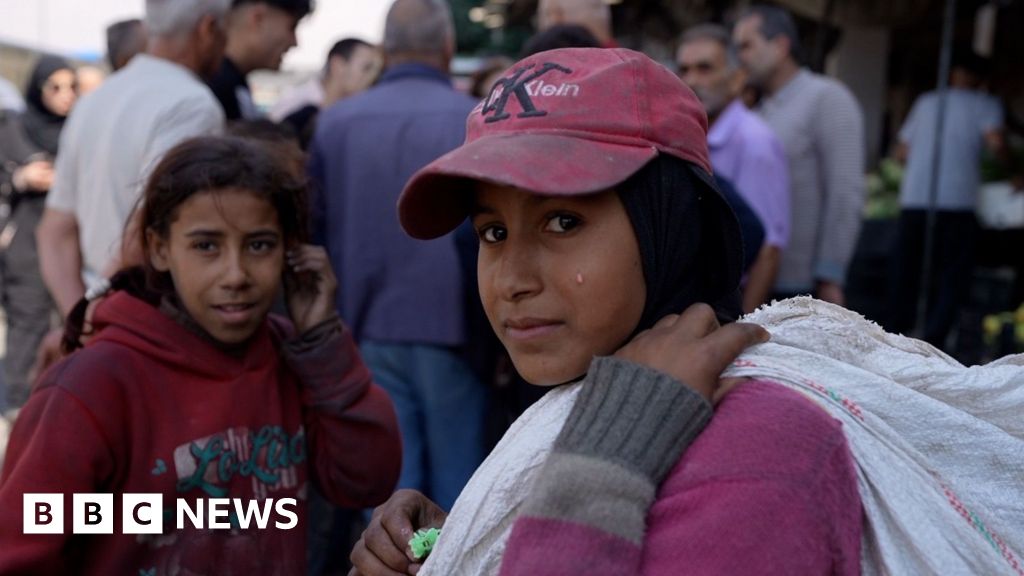
    Neha Sharma/BBC A girl wearing a pink baseball cap with a white sack over her shoulder looks at the camera, with a second girl behind her and a crowd of people behind them standing further awayNeha Sharma/BBC
    Many Syrians say their economic situation has worsened in the last two years amid a cost-of-living crisis

    Last month, protests erupted in squares and streets across Syria. People burned tyres, blocked roads and chanted slogans, angry at the government’s decision to raise fuel prices again. It was the largest show of discontent yet since President Ahmed al-Sharaa came to power two years ago.

    Speaking on a Syrian TV channel, a man said he still supported the authorities but that his situation had deteriorated to the point where he could no longer afford to buy bread. “Honestly,” another said, “we have begun to fear what kind of new decision each morning will bring”.

    The increase was the latest in a series of measures people blame for a growing cost-of-living crisis. For many Syrians, life, financially, has worsened since rebels led by Sharaa ousted President Bashar al-Assad, ending five decades of his family’s brutal rule and more than 13 years of a devastating civil war.

    Catapulted to the presidency, Sharaa has, since then, led Syria’s transition and efforts to revive a broken economy after a long period of mismanagement, isolation and conflict.

    From essential bills to basic items, the cost of virtually everything has gone up. And many saw a further and unexpected rise in fuel prices as a sign of a government out of touch with its country.

    “We don’t want roundabouts. Every day they build a new roundabout. People stood by you and are still with you,” another protester said, addressing Sharaa, “but this will [make] things explode”.

    Days later, amid calls for further demonstrations, the increase was revoked.

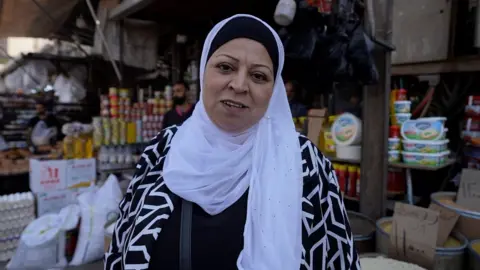
    Neha Sharma/BBC A woman in her 50s wears a white hijab and looks to the camera, in front of an outdoor market stand selling food itemsNeha Sharma/BBC
    “We eat more sparingly now. We no longer buy chicken once a week,” Fatima Saleh Eid says

    In a suburb of Damascus, I joined Fatima Saleh Eid at an open-air market for her weekly shop. At 50, she works as a cleaner to help support her family.

    “We’ve suffered a lot,” she said. Her husband had recently been hired by a ceramic factory after a year unemployed. He is among the lucky ones, as many are struggling to find work. In some streets, men gather in the hope of meeting someone offering a day job; often, they wait in vain.

    Since coming to power, the government has slashed long-held subsidies as part of an austerity drive. The price of bread, a Syrian staple, has increased tenfold. Fuel prices are now in line with the international average, which has put pressure on farmers and made transportation more expensive, while the cost of electricity has gone up several hundred per cent for some.

    The authorities, in response, have adjusted public sector wages, including pensions; unsurprisingly, the effect of the additional pay for people has been lost as prices keep rising.

    “We eat more sparingly now. We can’t afford chicken anymore nor meat. We only eat vegetables but even [that is] expensive,” Fatima said. “Inshallah [God willing] things will get cheaper.”

    As she spoke, around a dozen people, of all ages, gathered around us. Nobody disagreed. One elderly man also said he had stopped eating meat. Another, in his 20s, told me his family were no longer able to pay the medicine for his father, who had a heart condition. One young woman said she and her four children could only afford to have a proper meal every two days.

    Assad regime planned US journalist’s kidnap for weeks, BBC finds

    Global charity withholds report into its role in Syria’s ‘disappeared’ children

    The phone book that led us to Assad’s spy chief in hiding

    Marwan Bashour, a 68-year-old pensioner, said his monthly pay was around $90 (£70), which is the public sector minimum wage. “It’s not enough at all,” he said.

    The United Nations Development Programme said 90% of Syrians were in poverty last year.

    Marwan told me how he made ends meet.

    “Sometimes I borrow money, sometimes I sell things from my house,” he said, “like an old pot or plates that we never used, gifts that were given to us. I’ve even had to sell furniture”.

    There have been other pressures too. Like many Syrians, Marwan used to rely on help from aid agencies. But, for him, that has stopped, as organisations have been forced to cut back services because of funding cuts.
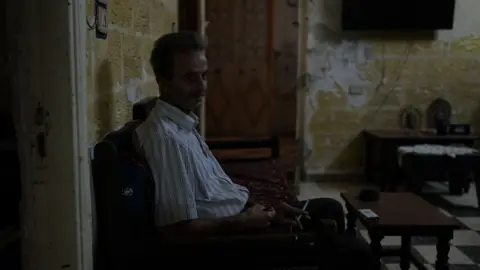
    Neha Sharma/BBC A man wearing a striped shirt sits in his living room in darknessNeha Sharma/BBC
    Nabil al-Remhein says he has cut back on lighting in his house because of high electricity bills

    Syria has also not been immune to the impact of the US-Iran war. The government said the fuel increase that led to the protests was, in part, due to the pressure on energy markets because of the conflict.

    I met another pensioner, Nabil al-Remhein, who is 63. None of his four adult children could find work. “We’re now having only one meal a day. It’s tragic,” he said. His face looked tired. “It isn’t only me. It’s the entire population. We’re all hungry… We’re suffocating under rising costs.”

    Nabil took me to his house, in a poor area of narrow alleys and modest buildings. There, I met his wife. She was doing her chores in the dark.

    “I’m afraid of the electricity bill,” Nabil said. “We’ve cut back on lighting up the house and we [also] turn off the fridge for about five hours a day”.

    Still, their latest bill was about a third of the family’s income. He has not paid it.

    Neha Sharma/BBC Profile of a woman heating up water on a stove standing in near darknessNeha Sharma/BBC
    Nabil al-Remhein’s wife does her chores in the dark in their house

    Dr Haid Haid, a Syrian columnist and consulting fellow at the London-based think tank Chatham House, said a “significant portion of the population” was worse off than before Assad’s fall.

    The economic crisis, he told me, was “one of the most dangerous issues” for the government, and that some of it was of its own making.

    “Part of [the crisis] is related to the lack of [financial] resources and the legacy left by the former regime,” he said.

    “But it’s also the direct impact of the new policies that are moving [Syria] towards a liberal and free-market sort of economy, which don’t take into account the impact on people”.

    A spokesman for the Syrian economy and industry ministry told me no-one was available for an interview.
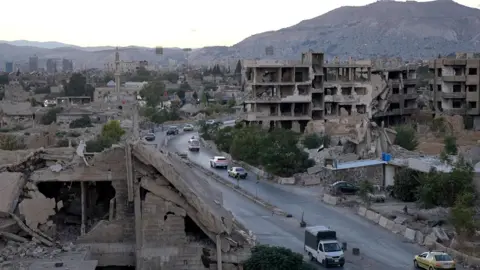
    Neha Sharma/BBC Wide shot shows a built up urban area with several tall buildings seriously damaged, a number of cars driving on a road running through the centre and mountains in the backgroundNeha Sharma/BBC
    Jobar, on the outskirts of Damascus, still lies in ruins nearly two years after the fall of the Assad regime

    Sharaa has, of course, scored some important gains.

    International sanctions imposed in the Assad-era have been lifted, and the US has removed the country from its list of state sponsors of terrorism.

    Security remains volatile and a source of concern, but the country feels more stable.

    And the president continues to consolidate his power and, earlier this year, retook the resource-rich north-east from a Kurdish-led militia. (The Druze still control areas in the south, where they want to create an autonomous state; Israel occupies parts of the south-west.)

    But real economic recovery is yet to happen. Large parts of Syria remain in ruins after a war that killed half a million people and displaced half of the population.

    Unable to afford rent, many families live in partially destroyed buildings. The World Bank says reconstruction costs are estimated at $216bn and, without foreign help and investment, it will be impossible for Syrians to rebuild.

    Samir Aita, a Syrian economist who heads the Circle of Arab Economists, a Paris-based independent think-tank, said the crisis was a “combination of policies with the [government] not managing expectations and creating unrealistic hopes”.

    When I asked him about how he felt about the future, he said: “It’s unsustainable. If they don’t change, I fear chaos.”

    Exhausted after years of conflict, Syrians, left with almost no choice, remain hopeful.

    Abu Mahmoud, a cab driver, told me: “They inherited the country bankrupt, so people need to be patient. Things don’t happen overnight.”

    Additional reporting by Lana Antaki, Samantha Granville and Neha Sharma

    Syria
    Economics
    Share. Facebook Twitter Pinterest LinkedIn Tumblr Email Telegram Copy Link
    Gulf News Week

    Related Posts

    Most Viewed News

    Many Cubans voted for Trump – now they're turning on Republican immigration policiesPresident Trump's fellow Republicans might feel the brunt of frustration among Cubans at the ballot box, writes the BBC's Will Grant.5 hrs agoUS & Canada

    October 30, 2026
    Most Viewed News

    Watch: Why Australia's mushroom murderer may now die in prisonJudges agreed with the prosecution’s appeal that Erin Patterson’s initial non-parole period of 33 years was insufficient.3 hrs agoAustralia

    October 30, 2026
    Most Viewed News

    Australian mushroom murderer loses appeal and gets harsher sentenceErin Patterson argued her trial was unfair due to seven grounds but three appeal judges dismissed them all.2 hrs agoAustralia

    October 30, 2026
    Most Viewed News

    Democrats have an identity crisis – it won't be an easy fixWhatever the result of the midterm elections, the party is facing tough questions over what they stand for and who should represent them.34 mins agoBBC InDepth

    October 30, 2026
    Most Viewed News

    Google value plunges by $500bn as AI fears rattle Wall StreetGoogle spooked investors so badly that its stock hit a six-month low, after it revealed its AI search summaries were affecting ad revenue.3 hrs agoTechnology

    October 30, 2026
    Most Viewed News

    Crypto giant Binance freezes $2.5bn of assets over suspected hackThe firm said deposits and withdrawals are suspended while its teams conduct security checks and will "cover all losses".8 mins agoBusiness

    October 30, 2026
    Add A Comment
    Leave A Reply Cancel Reply

    Editors Picks

    Syrians struggle with soaring prices as crisis challenges post-Assad recoveryFuel price rises are driving discontent, testing support for Ahmed al-Sharaa's government.48 mins agoMiddle East

    October 30, 2026

    Many Cubans voted for Trump – now they're turning on Republican immigration policiesPresident Trump's fellow Republicans might feel the brunt of frustration among Cubans at the ballot box, writes the BBC's Will Grant.5 hrs agoUS & Canada

    October 30, 2026

    Watch: Why Australia's mushroom murderer may now die in prisonJudges agreed with the prosecution’s appeal that Erin Patterson’s initial non-parole period of 33 years was insufficient.3 hrs agoAustralia

    October 30, 2026

    Australian mushroom murderer loses appeal and gets harsher sentenceErin Patterson argued her trial was unfair due to seven grounds but three appeal judges dismissed them all.2 hrs agoAustralia

    October 30, 2026
    Latest Posts

    Many Cubans voted for Trump – now they're turning on Republican immigration policiesPresident Trump's fellow Republicans might feel the brunt of frustration among Cubans at the ballot box, writes the BBC's Will Grant.5 hrs agoUS & Canada

    October 30, 2026

    Watch: Why Australia's mushroom murderer may now die in prisonJudges agreed with the prosecution’s appeal that Erin Patterson’s initial non-parole period of 33 years was insufficient.3 hrs agoAustralia

    October 30, 2026

    Australian mushroom murderer loses appeal and gets harsher sentenceErin Patterson argued her trial was unfair due to seven grounds but three appeal judges dismissed them all.2 hrs agoAustralia

    October 30, 2026

    Subscribe to News

    Get the latest sports news from NewsSite about world, sports and politics.

    Advertisement
    Demo
    Gulf News Week

    Your source for the serious news. This demo is crafted specifically to exhibit the use of the theme as a news site. Visit our main page for more demos.

    We're social. Connect with us:

    Facebook X (Twitter) Instagram Pinterest YouTube
    Latest Posts

    Syrians struggle with soaring prices as crisis challenges post-Assad recoveryFuel price rises are driving discontent, testing support for Ahmed al-Sharaa's government.48 mins agoMiddle East

    October 30, 2026

    Many Cubans voted for Trump – now they're turning on Republican immigration policiesPresident Trump's fellow Republicans might feel the brunt of frustration among Cubans at the ballot box, writes the BBC's Will Grant.5 hrs agoUS & Canada

    October 30, 2026

    Watch: Why Australia's mushroom murderer may now die in prisonJudges agreed with the prosecution’s appeal that Erin Patterson’s initial non-parole period of 33 years was insufficient.3 hrs agoAustralia

    October 30, 2026

    Subscribe to Updates

    Get the latest creative news from FooBar about art, design and business.

    © 2026 Gulf News Week. Designed by HAM Digital Media.
    • Home
    • Politics
    • Economy
    • Sports

    Type above and press Enter to search. Press Esc to cancel.