
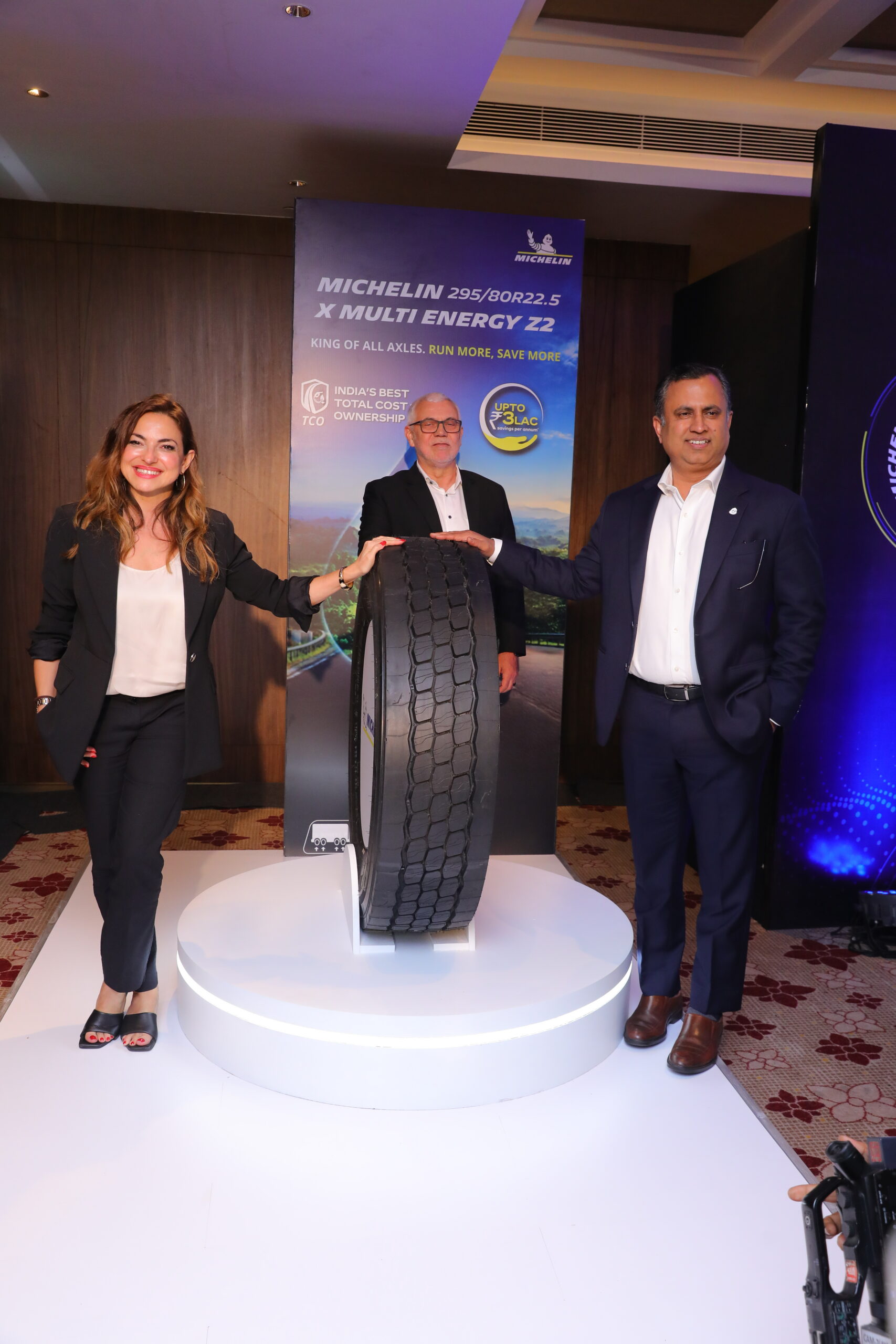
Michelin’s latest truck tyre innovation, unveiled in Chennai, could strengthen its longer-term prospects in the Gulf, where fleet operators face mounting pressure to cut fuel bills and the regional replacement tyre market is projected to exceed $5 billion by 2030.
The French manufacturer’s Made-in-India X Multi Energy Z2 promises fuel savings of up to 13 per cent, tyre life up to 25 per cent longer and stronger road grip compared with leading competitors. Developed for Indian highway conditions, the all-position truck and bus tyre became available nationwide on November 1, although Michelin has not announced its introduction in the Gulf.
The potential regional market is significant. Industry researcher Marqstats estimates the GCC replacement tyre business was worth $3.75 billion in 2025 and could reach $5.06 billion by 2030. Truck and bus tyres represented nearly 37 per cent of its value, while Saudi Arabia accounted for more than half of overall regional demand.
Fuel is among the largest expenses for heavy-duty fleets. Michelin estimates it represents around 50 per cent of fleet expenditure, making efficiency gains important to profitability. The company says its new tyre can improve fleet margins by up to three per cent under the conditions assessed.
The X Multi Energy Z2 comes in two sizes: 295/80R22.5, delivering claimed fuel savings of up to six per cent, and 295/90R20, offering up to 13 per cent. The comparisons are against leading competing tyres in the same sizes.
Three technologies underpin its performance. Michelin’s Carbion tread compound produces a stronger, more uniform rubber blend designed to resist wear. Duracore reinforces the tyre structure, with Michelin reporting 11 per cent better ply strength, potentially reducing failures and costly downtime.
Patented InfiniCoil technology optimises contact between tyre and road to enhance stability throughout its working life. In the 295/80R22.5 size, Michelin reports a road-contact footprint up to five per cent larger than that of competitors, supporting improved wet and dry handling and traction.
The fuel-saving figures come from tests conducted between June 22 and 28 on the Namakkal-Dindigul highway using an Ashok Leyland 16-wheeler. The projected 25 per cent longer tyre life, applicable to the 295/80R22.5 size, relies partly on internal simulations and performance data collected between 2023 and 2025.
Shantanu Deshpande, managing director of Michelin India, said fleet owners were “increasingly looking beyond the upfront cost of a tyre to its overall value throughout its life”. He described the product as a means to lower total ownership costs while improving productivity.
Michelin says the tyre incorporates up to 30 per cent recyclable materials. Its Chennai factory, which the company describes as operating with a zero-carbon footprint, sources nearly 45 per cent of its energy from renewables. Michelin also offers digital tyre monitoring and fleet-management solutions to help operators minimise downtime.
For Michelin, Chennai is increasingly an export and technology platform. Vitor Silva, president for Africa, India and the Middle East, has said: “Our priority is the local market. And then from here we can export.”
The plant already exports commercial truck tyres to the Middle East, while the Gulf and Africa are prospective initial destinations for its growing Indian-made passenger tyre range.
The Chennai facility has annual tyre capacity of about 54,000 tonnes, with future additions dependent on demand. Michelin has committed more than Rs3,400 crore to its operations there and plans to broaden its locally manufactured portfolio through 2027.
In the GCC, Michelin’s authorised Tyreplus network includes more than 80 multi-brand outlets, including 29 in the UAE as of June 2025. It has Saudi joint ventures but no tyre factories in the Middle East, which contributed less than one per cent of group revenue in 2025. Michelin has not published a separately verified GCC market-share figure.
Its October trading update showed original-equipment truck tyre demand rising three per cent in the combined Africa, India and Middle East region over the first nine months of 2026, while replacement demand slipped one per cent.
Esperanza Gaspar, Michelin’s truck and bus transportation business line director, highlighted plans to bring fleet operators and manufacturers from India, Africa and the Middle East together around the Chennai innovation, emphasising “Global reach. Local insights. Customer value.”
Explaining tyre efficiency more broadly, Cyrille Roget, Michelin’s scientific communication and innovation director, has observed: “The right tyre can really help you save money.”
For Gulf hauliers, the Chennai launch signals the savings that sophisticated tyre engineering may eventually deliver. Yet Michelin’s performance claims remain based on Indian tests and cannot be assumed to apply unchanged to Gulf heat, roads and operating loads.
