

 That Girl Boina
When popular Kenyan food creator That Girl Boina took a two-week holiday to Europe, she expected to relax. A week into the trip, an Instagram direct message exposed a problem that would ultimately lead to the closure of her business.
“I was at your studio, I liked everything. The only problem was that I was asked to send money to a different number. It wasn’t the number on the wall,” a customer wrote to her.
Boina had opened Waxaholic Studio, a waxing and hydrafacial parlour in Nairobi’s central business district, on 1 September 2024. A year later, she had hired a receptionist and two specialists and felt confident enough to take a two-week holiday, her first international trip of the year.
“I trusted them. It’s two rooms and a reception – how do you mess that up?” she recalls thinking.
The discovery prompted Boina to examine the business more closely. Although the business had made a profit in the first few months, revenue began to fall in early 2025. She initially dismissed the decline as a seasonal slump but then realised there was a problem.
“Everyone around was making money apart from me,” she says in hindsight.
She had already considered closing because it was not making a profit, but her initial investment, three employees depending on the business and her vision for it kept her going. The customer’s message became the turning-point.
“If I am not making money and I am willing to wait and see where this goes and you guys are not giving me the same energy, then why are we still open?”
Rather than confront the employees, Boina decided to close the studio. That weekend, she put it up for sale but found no buyer. She sold some of the equipment and took others, including decorations, home. Waxaholic Studio closed in October 2025.
“I remember my friend taking me to a restaurant, and I started crying. We were both silent.”
“What else would we do?”
Boina describes the experience as the worst feeling she has ever felt. The closure was not just a financial setback, but the loss of something she had built to secure her future.
In September, nearly a year after the business closed, Boina shared a video on TikTok recounting the experience, explaining that she had needed time to heal before speaking publicly about what happened.
The video went viral after being reposted on X, formerly Twitter, garnering close to one million views. It drew responses from many Kenyan business owners who described how theft, ranging from payment diversion to stock theft and the sale of expensive equipment, had pushed their businesses to the brink, forcing them to fire staff, sell their businesses or shut down.
“Although I have recovered emotionally, I am yet to recoup the money I invested in setting up and running the studio,” says Boina.
The reaction to her story showed that employee theft is a huge problem for many small businesses owners in Africa, where a handful of employees may control payments, stock and supplier transactions, often with limited oversight.
A 2022 survey by PwC, one of the world’s biggest consultancy firms, found that 63% of respondents in East Africa said their organisations had experienced economic crime, compared to a global figure of 46%.

 Getty Images
The risks are not confined to small businesses. Some of East Africa’s biggest supermarkets have also reported significant losses linked to employee fraud and stock theft. Tuskys and Nakumatt have both collapsed this decade amid wider financial and operational problems partly attributed to employee theft.
At its peak, Tuskys had more than 6,000 employees and over 60 branches across Kenya and Uganda. In 2015, the retailer hired loss-prevention firm Hipora Business Solutions East Africa to help tackle fraud. An audit found that Tuskys was losing more than 100m Kenya shillings (£581,000; $770,000) a month to employee theft, Business Daily reported. The alleged schemes included cashiers pocketing money, manipulating till transactions, and colluding with suppliers over goods received.
Nakumatt also suffered significant stock losses attributed to employee theft before going under, with a Kenyan policy firm reporting that more than $100m (£75m) worth of stock was unaccounted for.
Hipora, which works with businesses across East and Southern Africa, says employee theft is a huge problem, estimating that it accounts for more than 60% of losses recorded by small businesses.
Employee theft has evolved over the years, Hipora boss John Wanjohi tells the BBC. “Employees are like a cartel that colludes with clients and suppliers to perpetuate theft.”
Employee theft does not always involve money being diverted to an employee’s phone. It can sometimes take subtle forms, making it harder for business owners to detect.
 Cris Njoki
For Cris Njoki, founder of IKOJN, a Kenyan ready-to-wear clothes brand, the problem lay further up the supply chain.
“I found out that one of my staff was asking our suppliers to quote higher for some of the raw materials we were getting from them,” she says.
The employee allegedly colluded with a supplier to inflate prices, with the two sharing the excess money after the company paid the invoices. Njoki investigated the scheme and confronted the employee with the evidence. The employee subsequently left the company.
Since then, Njoki has tightened her firm’s procurement controls.
“We have now centralised the procurement process and created a paper trail. Finance speaks to the supplier and then makes payment,” she tells the BBC.
Across the continent in Accra, Ghana, employee theft came close to bringing Muftawu Nabila’s business to an end.
The Joy News sports journalist says he was robbed by two different employees in the four years he has run his electronics shop. But theft by a third employee, he says, nearly forced him to close it altogether.
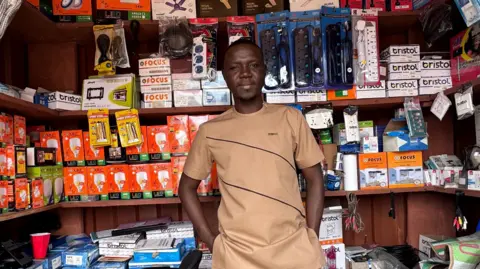 Nabila Muftawu
His first employee was let off with a warning. The second tripled monthly sales but left when her university semester resumed.
Before traveling to the United States to cover the Fifa World Cup in June 2026, Nabila hired a third attendant, leaving the business with little supervision.
“She almost collapsed my shop,” he says.
While other employees had taken smaller amounts, sometimes as little as 50 cedis ($4; £3) at a time, the third attendant was operating on a larger scale, he says.
“Assuming we are making a sale of $200 (£150) a day, she could take up to $30,” he says.
The theft continued for two months. When Nabila tried to restock the shop, he realised the money coming in was not enough to replenish his shelves. He began counting his stock every morning.
When he confronted the employee, she denied the allegations. But a stock count she conducted herself revealed a significant gap between inventory and sales receipts.
“I just told her: ‘If you go home today, don’t come back,'” he says.
His salary from his journalism job allowed him to rebuild the business.
For him, the shop is a way of creating jobs, making the theft particularly frustrating.
“We have to generate the money from the shop for me to pay you. So if I pay you, pay electricity bills, shop rent and you steal some, where am I expected to generate money?”
 Bloomberg via Getty Images
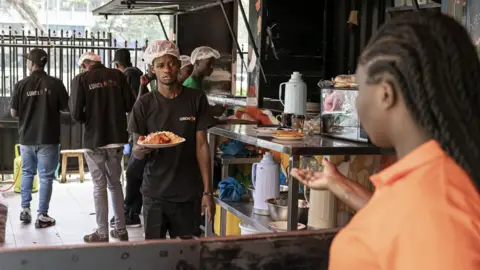
Theft happens in businesses around the world, but its consequences can be particularly severe for small businesses in Africa.
Many operate on tight margins, with limited access to finance, high borrowing costs and unpredictable tax environments.
Purchasing power is also lower in many African markets, limiting how much businesses can recover through sales or pass on to customers.
This is especially significant in a continent where the informal economy accounts for a large share of employment and economic activity.
For businesses without much of a financial cushion, the loss of cash, stock or equipment can threaten their ability to pay staff, restock or keep operating.
What might be a manageable loss for a larger company can push a small business to the wall.
Wanjohi says many small businesses lack proper safeguards to prevent theft.
At one struggling pharmacy branch, his team tightened controls over cash handling, stock movements, and cashier operations. Wanjohi says daily sales subsequently increased from 80,000 Kenya shillings to 200,000 after the changes.
Wanjohi says many businesses seek help from loss-control specialists only after the problem has become serious.
Detecting suspected theft, however, is only part of the challenge. Employers must also follow the law when investigating allegations and deciding whether to dismiss an employee.
Judith Guserwa, an advocate, says employers must investigate suspected theft, gather evidence and allow employees to respond before taking disciplinary action.
If employees admit to theft and choose to repay, let it be in writing: “If they don’t, you terminate with a valid reason and press charges,” she says.
The experience has changed how Boina approaches hiring.
She says she will now be slow to hire and quick to fire.
“I cannot teach you integrity,” she concludes.
You may also be interested in:

Go to BBCAfrica.com for more news from the African continent.
