Close Menu
    What's Hot

    How did Flávio Bolsonaro end up in Miami?BBC Verify has pieced together defeated presidential candidate Flávio Bolsonaro's journey through Brazil, Argentina and Ecuador to reach Miami.13 hrs agoBBC Verify

    October 29, 2026

    Building boom puts 300,000 people in the path of potential Himalayan disastersThe construction of tourism facilities, housing, and infrastructure has surged in parts of Nepal and India's Uttarakhand.7 hrs agoAsia

    October 29, 2026

    'Like cutting up a Picasso': AI microdrama edit of Neighbours worries actors and crewA micro-drama will use AI-assisted technology to edit old episodes of the Australian TV soap to focus on Margot Robbie's character.2 hrs agoAustralia

    October 29, 2026
    Facebook X (Twitter) Instagram
    • Politics
    • Economy
    Facebook X (Twitter) Instagram
    Gulf News Week
    Subscribe
    Thursday, October 29
    • Home
    • Politics
      • Europe
      • Middle East
      • Russia
      • Social
      • Ukraine Conflict
      • US Politics
      • World
    • Region
      • Middle East News
    • World
    • Economy
      • Banking
      • Business
      • Markets
    • Real Estate
    • Science & Tech
      • AI & Tech
      • Climate
      • Computing
      • Science
      • Space Science
      • Tech
    • Sports

      Dominant PSG put Liverpool on the brink with 2-0 Champions League quarter-final first-leg win

      April 9, 2026

      Dubai Basketball U-18 Elite Crowned Basket Cup Sarajevo 2026 Champions in Historic Debut

      April 6, 2026

      Saudi boxing crowns 20 champions as Kingdom’s Elite Belt concludes in Riyadh

      April 4, 2026

      “He Signed for a Real Fight”: Pacquiao Contradicts Mayweather Over Rematch Status

      April 3, 2026

      Arsenal Hold Off Chelsea Fightback to Reach Women’s Champions League Semi-Finals

      April 2, 2026
    • Health
    • Travel
    • Contact
    Gulf News Week
    Home»Most Viewed News»Building boom puts 300,000 people in the path of potential Himalayan disastersThe construction of tourism facilities, housing, and infrastructure has surged in parts of Nepal and India's Uttarakhand.7 hrs agoAsia
    Most Viewed News

    Building boom puts 300,000 people in the path of potential Himalayan disastersThe construction of tourism facilities, housing, and infrastructure has surged in parts of Nepal and India's Uttarakhand.7 hrs agoAsia

    Gulf News WeekBy Gulf News WeekOctober 29, 2026No Comments7 Mins Read
    Share Facebook Twitter Pinterest Copy Link LinkedIn Tumblr Email VKontakte Telegram
    Building boom puts 300,000 people in the path of potential Himalayan disastersThe construction of tourism facilities, housing, and infrastructure has surged in parts of Nepal and India's Uttarakhand.7 hrs agoAsia
    Share
    Facebook Twitter Pinterest Email Copy Link
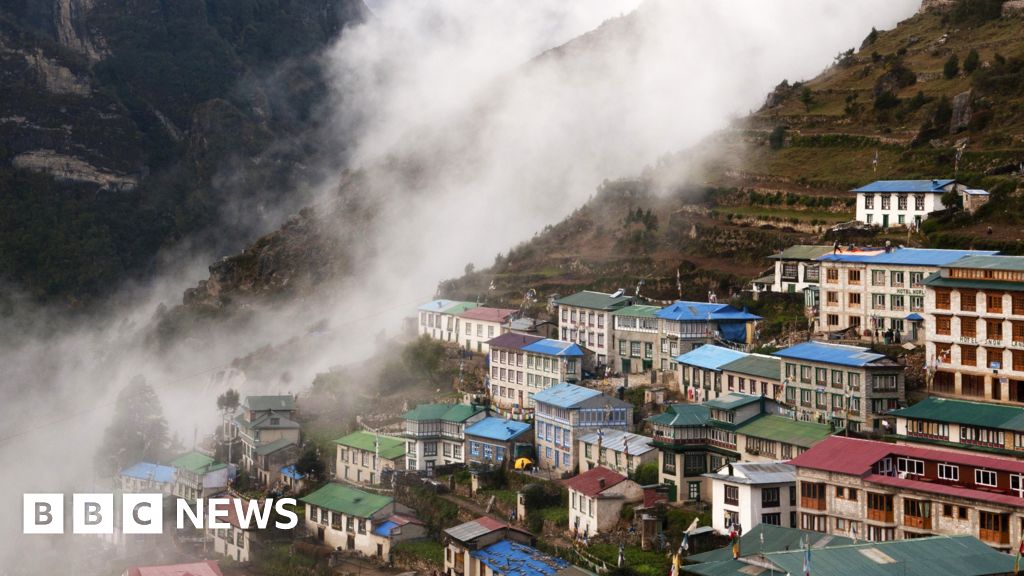
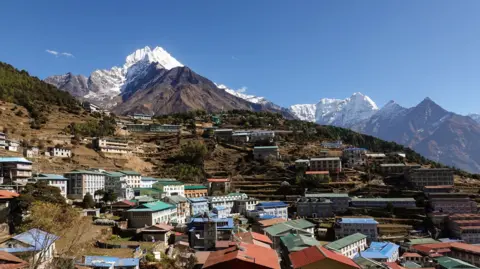
    Didier Marti Namche Bazaar's colourful rooftops spread across terraced hillsides in Nepal's Everest region, with the snow-capped peak of Mount Thamserku towering above the town under a clear blue sky.Didier Marti
    Construction of tourism and housing facilities has surged in parts of Nepal and India’s Uttarakhand

    At least 300,000 people in parts of the Himalayan region could now be living in the path of potential disasters, a new study suggests.

    Researchers found that the amount of built-up land in high-risk zones in northern Nepal, parts of south-eastern Tibet and a corner of India’s Uttarakhand had grown by about 45% between 2016 and 2023.

    In areas particularly threatened by flooding from glacial lakes, development increased even faster, rising by almost 78% over the same period, according to the peer-reviewed study published in Scientific Reports.

    The team of scientists behind it said the true number of people under threat could be much higher, as they only analysed a specific territory and not neighbouring areas which face similar risks.

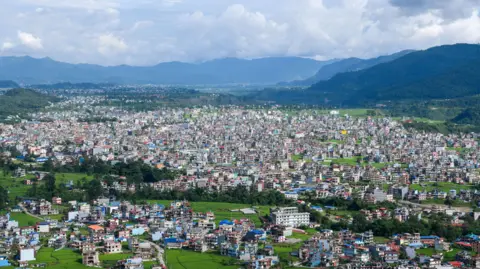
    Piyas Biswas/SOPA Images/LightRocket via Getty Images A panoramic view of Pokhara, Nepal, showing a dense spread of homes and low-rise buildings interspersed with bright green fields across a broad valley. Forested hills and mountains surround the city in the distance beneath towering clouds and a hazy blue sky.Piyas Biswas/SOPA Images/LightRocket via Getty Images
    The major tourist hub of Pokhara has seen major development in recent years

    Nine researchers from the UK, Nepal and India looked at areas up to 50km (30 miles) downstream from Himalayan rivers, as well as around 1,360 glacial lakes.

    They found significant development in these areas – including an expansion of tourism facilities, infrastructure development and real estate.

    It’s clear in Pokhara, a major tourism hub at the foot of the Himalayas that’s grown significantly in the past 30 years to cater for a massive increase in visitors.

    Mayor Dhana Raj Acharya says it’s a huge challenge to deal with the risk posed by the Seti Gandaki River, which stems from the Annapurna mountain range and flows right through the city. Many old buildings are just 5m (16ft) from river banks, he says, despite new rules requiring them to be further away.

    “Where we move them, and how we do that, is the real challenge.”
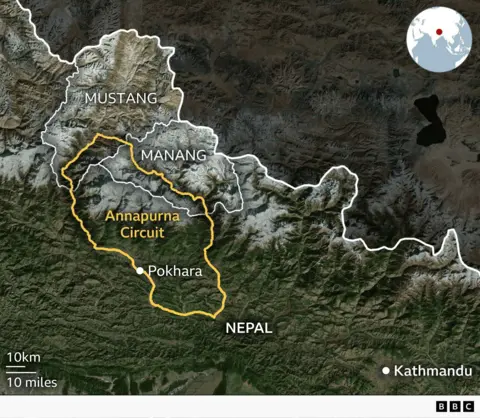
    A basic map showing the districts of Mustang and Manang, and how the Annapurna Circuit weaves its way through both of them.

    To the north is the world-renowned Annapurna trekking region that has also seen a major increase in settlements along river banks – some hit by recent floods and landslides.

    Phurpa Chhiring Lama, who runs a homestay there, feels helpless. Normally all of his 20 rooms are occupied at this time of year – the peak trekking season – but now only five are. “We have been doing this business for more than 40 years, but we’ve never seen this kind of disaster.”

    Krishna Gauchan, whose hotel is close to the glacier-fed Modi river, is worried too. “This river can flood if the glacier collapses or if the glacial lake bursts out and we are living in constant fear.”

    Tourism investors promote some of these spots as destinations without factoring in the risks, suggests Khagendra Poudel, a geographer at a local campus of Tribhuvan University. It’s similar to what’s happening in parts of north India’s Himalayan valleys which host major pilgrimages.

    The president of the Hotel Association Pokhara admits tourism businesses have expanded “without any proper planning” in the region and been promoted “haphazardly”.

    “By the time disasters hit, it is too late,” says Laxman Subedi. “As a professional body we are trying to create awareness among tourism entrepreneurs and investors.”

    Moment buildings are swept away as flash flood hits Nepal’s Budhi Gandaki river

    But it’s not just tourism. The regions surrounding the Bhotekoshi and Trishuli rivers have seen a significant rise in the construction of hydropower plants.

    “As river valleys become increasingly populated, development decisions being made today will shape disaster risk for decades to come,” warns the study’s lead author, University of Leeds glaciologist C Scott Watson.

    And even more buildings may be under threat than those identified by the researchers.

    The study categorised buildings at risk as all those that were within 50 vertical metres (164ft) of a river or glacial lake’s surface.

    But during the catastrophic flooding on 26 August, locals in Rasuwa district say the river level had risen by 70m (230ft) at some points – so even buildings that were relatively far from the river banks were hit and buried by debris-sludge.
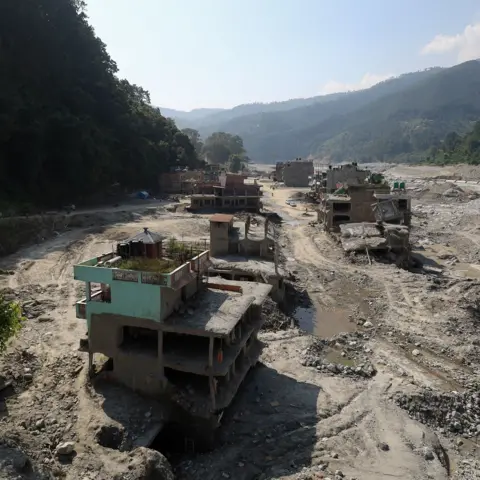
    Subaas Shrestha/NurPhoto via Getty Images Flood-damaged buildings in a vast landscape of mud, gravel and debris in Trishuli Bazar, Nepal, nearly two months after devastating floods swept through the valley. Several structures are partially collapsed or left stranded above eroded ground, while a widened river channel and scarred floodplain stretch through the settlement between steep, forested hills.Subaas Shrestha/NurPhoto via Getty Images
    Two months after the devastating August floods, these buildings in Trishuli Bazar remain devastated

    The risks in all of these areas are largely driven by warming in the Himalayan region, which scientists say is happening at twice the global rate. This has sped up the melting of glaciers, icefields, snowpacks, and ground that’s normally frozen all year.

    This can, in turn, destabilize mountain slopes which are also frequently shaken by earthquakes, unleashing devastating disasters downstream.

    The rapid melting is also filling up and expanding glacial lakes until they burst, causing deadly floods. Nepal alone has documented around 30 of these events since 1940.

    Another issue is that rising temperatures cause rain to reach high altitudes where it used to only snow, leading to slope failures, rock and ice falls, and other disasters.

    Nepal’s Prime Minister Balendra Shah raised the dangers of climate change at his recent UN General Assembly speech, where he said his country was paying a “colossal price” for a crisis it did not create.

    “Every major disaster threatens to erase years of development. And it forces a poor country to borrow money to repair damage it did not cause.”
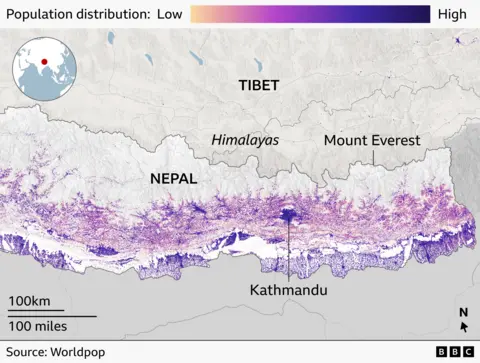
    Map of Nepal showing population distribution, with densely populated areas highlighted in dark purple and sparsely populated areas in pale shades. Most of the population is concentrated in a broad east-west band across the southern foothills of the Himalayas, including around Kathmandu, while the high Himalayan region near Mount Everest and the Tibetan border is sparsely populated. An inset map marks Nepal's location in Asia.

    Alton Byers, a mountain geographer at the University of Colorado who was not involved in the study, says it should serve as a “springboard” to bring about more effective early-warning systems and other precautionary measures.

    But achieving that will be a challenge. Campaigners say building regulations aren’t implemented on the ground and through the years, development has been haphazard in too many places.

    Roads, hydropower projects, hotels and market towns have expanded on the low, flat land along rivers, which is accessible and buildable, says Prof Surya Raj Acharya, an urban planning expert and registrar at the University of Nepal.

    Those responsible have often ignored safeguards including keeping off the river bank, he adds.

    “A fragile ecosystem like the Himalaya demands stricter planning and building regulations than elsewhere, yet these rules have been weak and poorly enforced.”

    Authorities in Nepal say they are working to address these issues. Settlements within 15m (49ft) of the riverbank along the recently devastated Rasuwa-Bhotekoshi corridor will soon be banned, according to the national disaster agency. Similar rules are being introduced in other river corridors soon.

    “It is a challenging job because people in many places have sentimental attachments with their land and property but we cannot ignore the increasing risks,” says chief executive Dharam Raj Uprety.
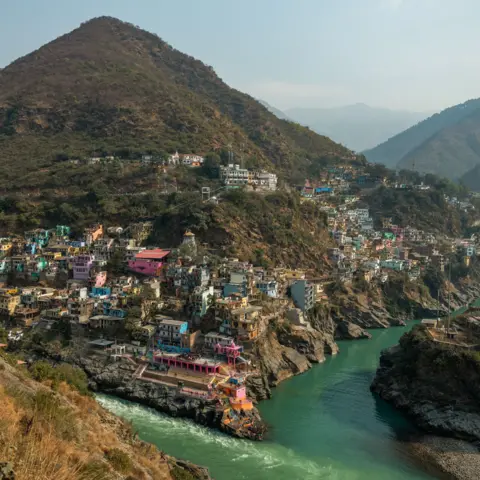
    Bloomberg The turquoise waters of two rivers meet at Devprayag in the Indian Himalayan state of Uttarakhand, with colourful buildings clustered on steep rocky hillsides above the confluence. Surrounded by rugged mountains, the rivers wind through a narrow valley lined with temples, homes and roads carved into the slopes.Bloomberg
    There has been “rampant construction” in the Indian state of Uttarakhand in areas at risk from flooding, activists say

    A similar story has unfolded across Nepal’s western border in India’s Uttarakhand state, where maximum tourism limits and environmental regulations have been bypassed in the name of economic growth, claims activist Anoop Nautiyal.

    On paper there are zoning rules prohibiting the construction of houses and infrastructure too close to river banks, “but on the ground we see no implementation of such rules.

    “You can see rampant construction all over.”

    The Uttarakhand government on 12 October approved new floodplain zoning rules to regulate land use and development. “Its objective is to protect life, property and important infrastructure from possible flood damage while maintaining the natural flow of flood waters,” the state’s cabinet decision read.

    But Basanta Raj Adhikari, director of the Centre for Disaster Studies at Tribuvan University, thinks it will not be possible to mitigate such threats completely.

    Insurance grades, he suggests, could be another way to encourage people to build in less risky areas. If authorities were to map places as high, moderate and low risk, he believes insurance coverage would “follow accordingly” ensuring people who build homes in safer areas get better protection.

    But for now, the pace of construction across the region shows no signs of slowing.

    India and China aren’t friends – but Nepal wants to unite them against climate threats

    Homes and bridges swept away as fresh floods hit Nepal

    Many Nepalis swept away in the floods aren’t officially dead, leaving families in limbo

    Nepal
    The Himalayas
    India
    China
    Tibet
    Floods
    Glaciers
    Climate
    Share. Facebook Twitter Pinterest LinkedIn Tumblr Email Telegram Copy Link
    Gulf News Week

    Related Posts

    Most Viewed News

    How did Flávio Bolsonaro end up in Miami?BBC Verify has pieced together defeated presidential candidate Flávio Bolsonaro's journey through Brazil, Argentina and Ecuador to reach Miami.13 hrs agoBBC Verify

    October 29, 2026
    Most Viewed News

    'Like cutting up a Picasso': AI microdrama edit of Neighbours worries actors and crewA micro-drama will use AI-assisted technology to edit old episodes of the Australian TV soap to focus on Margot Robbie's character.2 hrs agoAustralia

    October 29, 2026
    Most Viewed News

    Netanyahu's bloc leading Israel election but short of majority, partial results showWith 85% of ballots counted, Netanyahu's Likud party and its allies are set to win 53 seats in the 120-seat Knesset.8 hrs agoMiddle East

    October 29, 2026
    Most Viewed News

    Has Flávio Bolsonaro fled Brazil to evade justice?The BBC's Ione Wells looks at whether the defeated right-wing presidential candidate travelled to the US to avoid an ongoing criminal investigation.8 hrs agoUS & Canada

    October 29, 2026
    Most Viewed News

    Flávio Bolsonaro denies fleeing Brazil after landing in MiamiThe defeated Brazilian candidate claims to be the victim of a coup d’état and political persecution, recycling unsubstantiated allegations of “electoral fraud”.1 hr agoUS & Canada

    October 29, 2026
    Most Viewed News

    Family row over George Michael items up for auction – including Faith guitarThe brother of the singer's late personal assistant says she would not have wanted the items to be sold.1 hr agoCulture

    October 29, 2026
    Add A Comment
    Leave A Reply Cancel Reply

    Editors Picks

    How did Flávio Bolsonaro end up in Miami?BBC Verify has pieced together defeated presidential candidate Flávio Bolsonaro's journey through Brazil, Argentina and Ecuador to reach Miami.13 hrs agoBBC Verify

    October 29, 2026

    Building boom puts 300,000 people in the path of potential Himalayan disastersThe construction of tourism facilities, housing, and infrastructure has surged in parts of Nepal and India's Uttarakhand.7 hrs agoAsia

    October 29, 2026

    'Like cutting up a Picasso': AI microdrama edit of Neighbours worries actors and crewA micro-drama will use AI-assisted technology to edit old episodes of the Australian TV soap to focus on Margot Robbie's character.2 hrs agoAustralia

    October 29, 2026

    Netanyahu's bloc leading Israel election but short of majority, partial results showWith 85% of ballots counted, Netanyahu's Likud party and its allies are set to win 53 seats in the 120-seat Knesset.8 hrs agoMiddle East

    October 29, 2026
    Latest Posts

    How did Flávio Bolsonaro end up in Miami?BBC Verify has pieced together defeated presidential candidate Flávio Bolsonaro's journey through Brazil, Argentina and Ecuador to reach Miami.13 hrs agoBBC Verify

    October 29, 2026

    'Like cutting up a Picasso': AI microdrama edit of Neighbours worries actors and crewA micro-drama will use AI-assisted technology to edit old episodes of the Australian TV soap to focus on Margot Robbie's character.2 hrs agoAustralia

    October 29, 2026

    Netanyahu's bloc leading Israel election but short of majority, partial results showWith 85% of ballots counted, Netanyahu's Likud party and its allies are set to win 53 seats in the 120-seat Knesset.8 hrs agoMiddle East

    October 29, 2026

    Subscribe to News

    Get the latest sports news from NewsSite about world, sports and politics.

    Advertisement
    Demo
    Gulf News Week

    Your source for the serious news. This demo is crafted specifically to exhibit the use of the theme as a news site. Visit our main page for more demos.

    We're social. Connect with us:

    Facebook X (Twitter) Instagram Pinterest YouTube
    Latest Posts

    How did Flávio Bolsonaro end up in Miami?BBC Verify has pieced together defeated presidential candidate Flávio Bolsonaro's journey through Brazil, Argentina and Ecuador to reach Miami.13 hrs agoBBC Verify

    October 29, 2026

    Building boom puts 300,000 people in the path of potential Himalayan disastersThe construction of tourism facilities, housing, and infrastructure has surged in parts of Nepal and India's Uttarakhand.7 hrs agoAsia

    October 29, 2026

    'Like cutting up a Picasso': AI microdrama edit of Neighbours worries actors and crewA micro-drama will use AI-assisted technology to edit old episodes of the Australian TV soap to focus on Margot Robbie's character.2 hrs agoAustralia

    October 29, 2026

    Subscribe to Updates

    Get the latest creative news from FooBar about art, design and business.

    © 2026 Gulf News Week. Designed by HAM Digital Media.
    • Home
    • Politics
    • Economy
    • Sports

    Type above and press Enter to search. Press Esc to cancel.